Artificial Intelligence has become the default answer to almost every business problem.
Need to automate invoices? Use AI.
Need to process sales orders? Use AI.
Need to extract information from documents? Use AI.
The enthusiasm is understandable. But in our experience, it often leads organizations to solve the wrong problem with the wrong technology.
Recently, we assessed the sales order process for a large distribution business processing more than 500 customer orders each day. The expectation was clear: build an AI-powered solution.
Instead of starting with the technology, we started with the process.
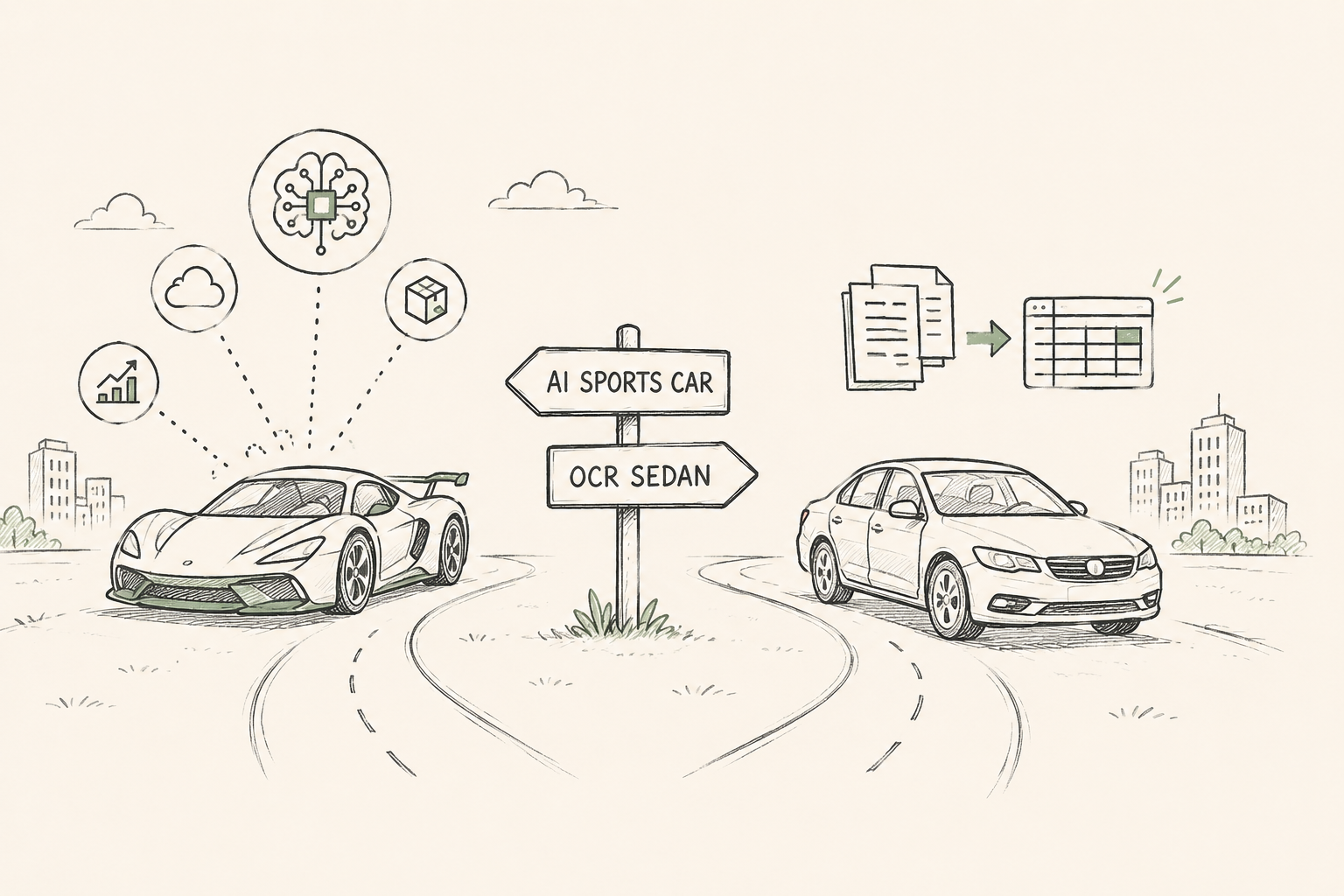
The analysis revealed that nearly 80% of the documents followed a predictable structure. Traditional OCR combined with business rules could accurately extract customer details, products, quantities, and pricing with minimal complexity. Only the remaining 20%—where documents varied significantly, contained handwritten notes, or required contextual interpretation—benefited from AI.
The outcome was not just a simpler architecture. It was a better business decision.
The organization reduced implementation complexity, avoided unnecessary recurring AI inference costs, accelerated deployment, and achieved faster return on investment. More importantly, AI was reserved for the tasks where it created genuine value rather than being used indiscriminately.
This reflects a broader lesson for digital transformation.
AI is not a replacement for process analysis. It is an accelerator for the parts of a process that conventional automation cannot solve efficiently.
Organizations that apply AI to every workflow often increase cost and complexity without improving outcomes. Those that first identify what can be standardized, automated, or optimized through conventional technologies—and then apply AI selectively—tend to achieve better economics and more sustainable results.
The future does not belong to organizations that use the most AI.
It belongs to those that know where AI matters—and where it doesn’t.
In technology, as in business, the smartest solution is rarely the most sophisticated one.
Sometimes, an OCR sedan gets you to the destination faster than an AI sports car.
.svg)


.jpg)

