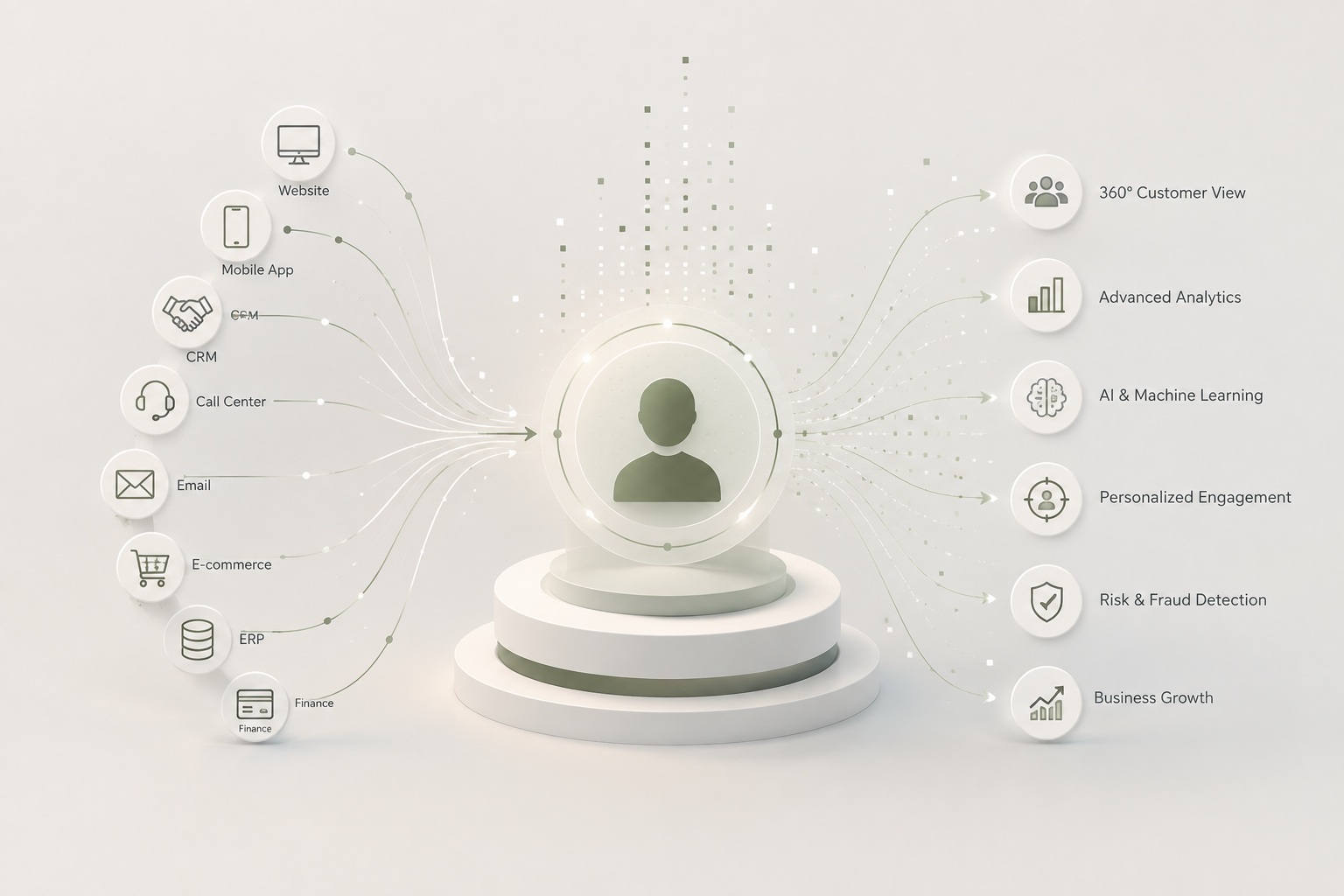
A Customer Data Platform built on Databricks unifies fragmented data into a trusted customer view. This enables AI-driven insights, personalization, and smarter business decisions.
Every organization believes it knows its customers.
Yet, ask a simple question—“How many unique customers do we actually have?”—and the answer is often surprisingly difficult to find.
The same customer may exist in your ERP, CRM, website, mobile application, loyalty program, call center, marketing platform, and finance system, each with a different identifier and slightly different information. Every department believes its data is correct, yet none possesses the complete picture.
The challenge is no longer collecting customer data. The challenge is making sense of it.
This is where a Customer Data Platform (CDP) transforms the enterprise.
A CDP is far more than another database. It creates a single, trusted, intelligent customer profile by bringing together information from every business system. Instead of multiple versions of the same customer, organizations gain one unified identity—a true 360-degree customer view that becomes the foundation for analytics, artificial intelligence, and strategic decision-making.
Building this foundation requires more than traditional data warehousing. Modern enterprises generate structured and unstructured data at an unprecedented scale, demanding a platform that can ingest, process, govern, and analyze information in real time. This is why many organizations are turning to Databricks.
Built on a modern Lakehouse architecture, Databricks combines the scalability of data lakes with the performance of data warehouses, enabling organizations to unify customer information across hundreds of systems without creating additional data silos. More importantly, it allows data engineering, analytics, machine learning, and AI to operate on the same trusted data foundation.
Imagine a customer who browses products through a mobile app, purchases online, visits a physical store, contacts customer support, responds to marketing campaigns, and makes payments through multiple channels. Without a CDP, these interactions remain disconnected, forcing every department to work with only part of the customer’s journey.
With Databricks, those interactions become one continuous story.
Artificial Intelligence then elevates this unified data from historical reporting to predictive intelligence. Instead of simply knowing who the customer is, organizations can anticipate who is likely to purchase next, identify customers at risk of leaving, detect fraudulent behavior, recommend products with greater accuracy, personalize engagement, and estimate customer lifetime value. The conversation shifts from “What happened?” to “What is likely to happen next?”
The business impact extends far beyond marketing. Sales teams gain a complete understanding of customer relationships before every meeting. Customer service agents respond with full historical context instead of isolated transactions. Finance teams produce more accurate reporting. Executives make strategic decisions based on trusted enterprise-wide data rather than fragmented departmental reports.
Across industries, the opportunities are equally transformative. Healthcare providers can build a unified patient profile across clinical, operational, and financial systems. Retailers can connect in-store and digital purchasing behavior to deliver personalized experiences. Banks can combine customer interactions across cards, loans, digital banking, and branch networks to improve engagement and risk management. Telecommunications companies can understand subscriber behavior across billing, network usage, customer support, and digital channels. Government organizations can create a secure and governed single citizen view that improves service delivery while maintaining regulatory compliance.
The true value of a Customer Data Platform is not measured by the volume of data it stores. It is measured by the quality of decisions it enables.
Organizations that continue to operate with fragmented customer information will struggle to deliver personalized experiences, adopt AI effectively, and compete in an increasingly data-driven economy. Those that invest in a modern Customer Data Platform built on Databricks establish a trusted digital foundation from which every analytics initiative, AI model, and customer engagement strategy can grow.
The future of customer intelligence does not belong to organizations with the most data.
It belongs to organizations that can transform disconnected information into a single source of truth—and turn that truth into action.
.svg)


.jpg)

